Wednesday, March 21, 2012

The Franklin


The Franklin travels with the Man of Law. He has a white beard, and he is a gentry land-owner, a member of the nobility.

One of the most important obligations of this social role is to provide generous hospitality, so he keeps his pantry well-stocked with food and wine. Unlike most noble hosts, who would generally take apart their table between guests to make room for other things in the hall, the Franklin keeps his table ready and waiting at all times.

He takes pleasure in eating and drinking, and in providing pleasure to others with entertaining.
The Franklin also is a "knight of the shire," or advisor at parliamentary sessions, and has served as a sheriff and tax auditor. This public service coupled with his generous hospitality and cheerful temperament mark the Franklin as an upstanding representative of his social class.

When he is going to tell his story, the Franklin begs the indulgence of the crowd because he is an uneducated man and simple in his speech. He has never learned rhetoric, and he speaks simply and plainly. His story is a traditional Breton tale, which is focuses on issues of providence, truth and generosity in human relationships.

The Yeoman


Hello! I am the Yeoman. I am the Knight’s second servant. Unfortunately, I do not tell a story, but I must tell you something. The Knight’s story in The Canterbury Tales is mine.
I am a thin person, tall and brainy. I think that I am polite and hard-working. I always try to make everything well. I am thirty years old. I do not have a wife or children but one day, I want to have a family.
I have been the Knight servant since I was ten. When I was a child, I was a beggar. I was alone because my parents had been killed by The Black Death. I was really sad. One day I asked the Knight for some money. He answered me that if I was be able to tell a story, he would give me some money. I told him the story about the Greek Dukes that probably you have read. He really loved the story so he told me if I would like to work in his house. And I became his servant.
He taught me how to use a sword and when I was fifteen he gave me a bow and some arrows. I love the Knight as my own father and he loves me as a son. I think that this is the reason why the Knight’s son is a bit jealous of me but I do not mind because he is a good person too.
I am on pilgrimage with the Knight because I want to go with him everywhere he goes and serve him the best I can.

The Friar

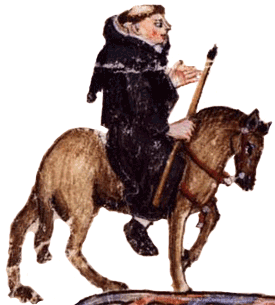
The Friar is a person who is able to get money from the people through every vicious and immoral method. Huberd, the Friar’s name, wears his common clothes (habit) in The Canterbury Tales.

The Friar’s extracurricular activities are inappropriate for one of his profession: we learn that he likes to hang out with wealthy landowners, barmaids, noblewomen, and tavern owners. St Francis, the first friar said that he would spend time with the poor and sick. But the Friar says he sees no reason for someone of his station to hang out with poor people. And finally, we learn that the Friar excels at singing competitions and debate, resolving disputes at "love days" or court days. We know that this is no proper occupation for a Friar because the narrator tells us so: in this, says Chaucer, he is not like a poor scholar friar, but more like a master or a pope. And judging from his portrait, that's probably exactly how this friar would like to be perceived.

The Friar's Tale

The Friar's Tale is about an archdeacon's summoner extremely adept in discovering those against whom the Church declares malevolent. The Church has strict laws against fornication, witchcraft, and lechery. Although immoral to the core, the summoner was powerful in discovering the lechers and forcing them to pay large amounts to the church. The Summoner in the group of pilgrims interrupts the Friar's tale with concern; however, the fair host allows the Friar to persist with his story. A feud has developed between these two pilgrims to Canterbury: the Friar and the Summoner. The Friar insists that his summoner would only summon those who had money to actually pay the church and would also hire the help of prostitutes, who in exchange for names of clients would be given safety. Incidentally, the summoner also hired those prostitutes for sexual services.

The Clerk


The Clerk

The Oxford clerk is among Chaucer’s idealized portraits. The Clerk is a serious student who had long ago devoted himself to the study of logic. Perhaps he is studying for a Master’s degree.

He is very thin, hollow and pale and his horse is as thin as a rake. He does not have any benefice and is extremely poor which is evident from his threadbare short upper coat. He prefers to single - mindedly pursue his insatiable quest for knowledge and learning rather than mindlessly run after wealth and riches. He would rather have twenty books of Aristotelian philosophy at his bedside than fine clothes, fiddle or a harp.

Although he is a philosopher he has little gold in his coffer. He is a man of few words and does not speak more than necessary. But whatever he does say tends to increase moral virtue in the listeners. The scholarly Clerk religiously prays for the welfare of his friends and benefactors. Chaucer seriously appreciates the Clerk’s solemnity and openly praises him. There are no ironic overtones in the Clerk’s portrait apart from the pun on his being a philosopher and yet being poor.

In the Middle Ages, a philosopher also implied an alchemist who claimed to transform base metals into silver and gold. Chaucer’s Clerk does not have gold in his coffer. He is a serious student of logic and philosophy and has willingly forfeited worldly pleasures for intellectual enrichment. 


THE DOCTOR

He is a man who loved the gold . He know all the medical authorities by heart but he doesn't know the bible. He ripped people off during the black plague and made lots of money. He prescribed gold for.


What does the doctor in the Canterbury tales do?

The doctor is a very strange person who knows about the medicine. He knew astrology and something of nature and could utter the suitable humor to make laugh the patients. He knows a little about astronomy. Chaucer doesn’t like the doctor in the Canterbury Tales. He wears an old floral dress and prada patent leather heels.

The Doctor's Tale

A knight named Virginius had a daughter who was fourteen years old. She was a virtuous girl, and mature before her years, as evidenced by the fact that she did not need an escort when she went out. She was walking in town one day, and a judge of the area felt lustful thoughts towards her, and wanted to obtain her by any means he could. But, he knew that he could not convince her to partake in lust, so he asked for advice from a sly friend of his. They devise a scheme. They take a false document to her father that claims she is not his daughter, and they bring false witnesses so that he cannot argue otherwise. The knight weeps, and tells his daughter that she must either die or go with the evil judge and his friend. She decides to die rather than go with the men, and after some time to prepare herself, she lets her father cut off her head. He takes it to the judge, who tries to arrest the knight, but loyal friends who know of the judge's evil treachery save the knight. Virginus pleaded for mercy for the evil men, and they were exiled and not killed.

Canterbury


CANTERBURY

Canterbury is a historic English cathedral city, which lies at the heart of the City of Canterbury, a district of Kent in South East England. It lies on the River Stour.

Originally a Brythonic settlement, it was renamed Durovernum Cantiacorum by the Roman conquerors in the 1st century AD. After it became the chief Jutish settlement,the name Canterbury, it derived from the Old English Cantwareburh. After the Kingdom of Kent's conversion to Christianity in 597, St Augustine founded an episcopal see in the city and became the first Archbishop of Canterbury, a position that now heads the Church of England and the worldwide Anglican Communion.

Thomas Becket's murder at Canterbury Cathedral in 1170 led to the cathedral becoming a place of pilgrimage for Christians worldwide. This pilgrimage provided the theme for Geoffery Chaucer's 14th-century literary classic The Canterbury Tales. The literary heritage continued with the birth of the playwright Christopher Marlowe in the city in the 16th century.


Many historical structures remain in the city, including a city wall founded in Roman times and rebuilt in the 14th century, the ruins of St Augustine's Abbey and a Norman castle, and perhaps the oldest school in England, The King's School. Modern additions include the University of Kent, Canterbury Christ Church University, the Marlowe Theatre, and the St Lawrence Ground, home to Kent County Cricket Club. The city lies at the heart of the City of Canterbury, a local government district.

THE SEA CAPTAIN

The Sea captain’s Tale suits his character. It is an immoral story narrated by a thoroughly immoral man.  The readers learn from the ‘General Prologue’ that the Sea captain is dishonest and has no qualms about stealing the wine that he is transporting for a Merchant. He owns his own ship named ‘Magdaleyne’ and is from Dartmouth. He is a tough captain and ruthless in his dealings with pirates.The beginning lines of the tale (lines 12 - 19) shows that the tale was designed for a female character, probably for the Wife of Bath where the Sea captain says that our husbands desire us to be wise and good in bed. But the tale suits the Sea captain’s character extremely well. 


       The Sea captain's tale
A merchant in the town of St. Denis had a beautiful and sociable wife.  They hosted many parties, and one of the merchant's best friends was a monk named Brother John, who was a generous man.  The merchant invited Brother John over for a holiday hospitality.  John had a moment alone with his friend's wife, and she asked him to sleep with her if he'll give her 100 francs. The next day, John met her husband, who was worried over a loan that he needs to pay.  John tells his friend that he has given his wife the money that he owed him, and the merchant happily went to fix his debt, and when he returned home, he was so happy to be debt-free that he made love to his wife all night.
When he mentioned John's 100 francs, his wife says that she used the money for worthy purposes, and that now she had a debt to her husband, and she will pay him back in the bedroom.  He laughed at her witty response, and they all lived happily ever after.